
Where to Get a Hollander Beater for Papermaking
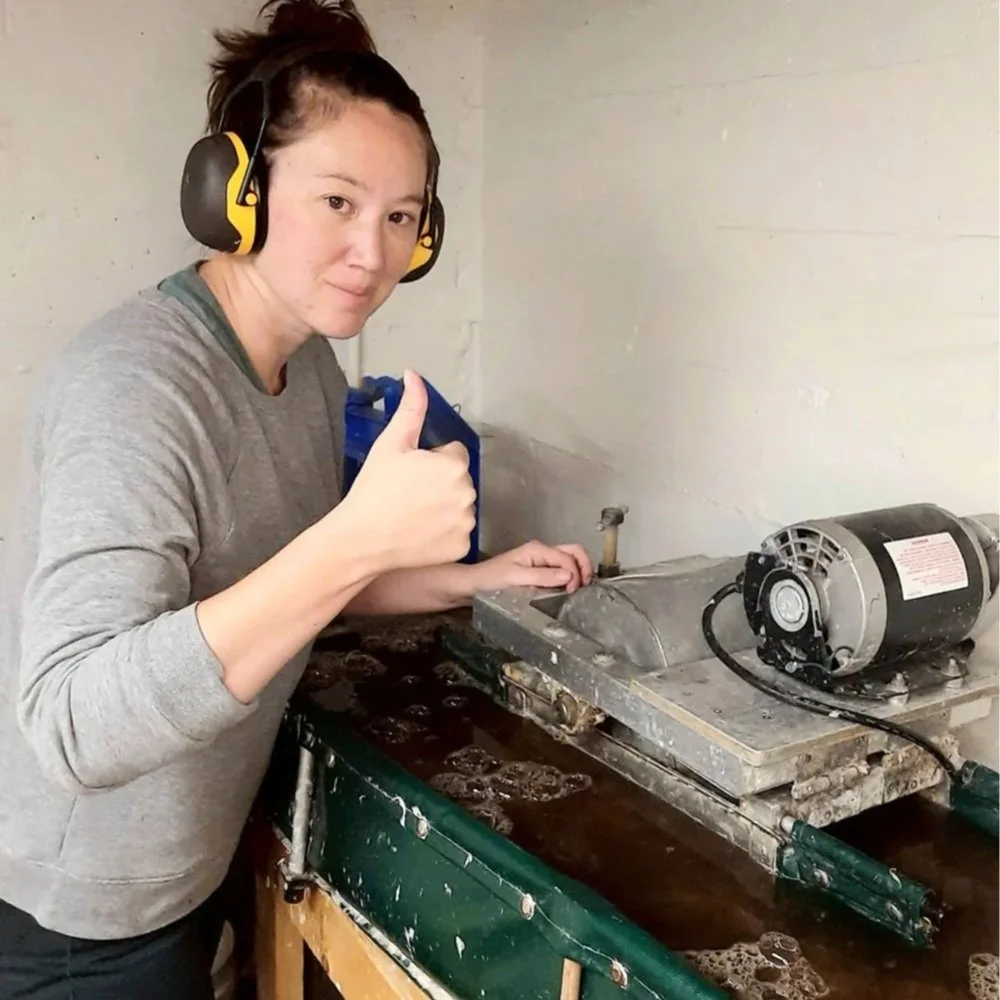
Hey, I’m May Babcock. Here I am with my Critter Hollander beater. I also have two other beaters, because who doesn’t need 3 Hollander beaters 😂💀.
Have you heard of the elusive “Hollander paper beater”? Ready to ditch the Cuisinart and graduate beyond blender papermaking? Hollander beaters are the heavy, expensive, and loud piece of studio papermaking equipment you’ll need to turn rags and tougher fibers into quality paper pulp.
How Hollander beaters work
Generally, there is an ovoid tub where water and your papermaking fiber travels around. Hidden under the round-ish cover is a roll with blades. As a motor turns the roll, the fibers are beaten between the blades and a bed plate that sits underneath the roll. A Hollander beater's main purpose isn't just to cut fibers, but to macerate and fibrillate fibers, promoting more surface area for fibers to bond together during the hand papermaking process.
Why you’d want one
Generally, you can achieve handmade paper that’s stronger, crisp, and dense. Say good-bye to fluffy, weak papers!
Make larger quantities of pulp.
You need a Hollander to pulp cloth rags and fabric.
You also need it for tougher fibers, like flax and hemp.
It’s how you make speciality fine, short pulp for certain pulp painting techniques.
It’s how you make high-shrinkage a.k.a “overbeaten” pulps for sculptural purposes. These are pulps that shrink and harden into incredible sculptural forms.
Fibers such as abaca, beaten for hours in a Hollander, can also be transparent and beautifully rattly if formed into a sheet.
Why you wouldn’t want one
They’re expensive. New, they can cost around $15,000 USD. Used and in operating condition, you’ll spend at least $1000 USD if you’re very lucky. Plus shipping and crating costs.
They are heavy. Some are cast iron! Others have collapsible tubs that make them somewhat easier to move.
They are loud. Running, they are basically grinding fiber down, so think of a loud, steady machine noise with bumps here and there as it works through fiber. A lot of papermaking studios have a separate beater room because they are loud.
If you want specialty pulp that only a Hollander beater can make, but you don’t want to buy a Hollander beater:
Find your local papermaking studio, and ask if they beat pulp as a service
Or, order pre-beaten pulps from papermaking suppliers
Pulping Options if You Don’t Want a Hollander Beater
Stick with the blender to do recycled papermaking, or purchase linters and half-stuff (dried pulp sheets) from papermaking suppliers.
Hand-beat with a mallet. This works best with long bast fibers, such as kozo or milkweed, and can produce thin but strong handmade papers. Many Eastern style papermaking traditions use hand-beaten bast fibers and specialized sheet formation tools and techniques, each with their own cultural richness and heritage.
Plant fibers are a great alternative if you want to expand your fiber repertoire without needing a Hollander beater. Many plants can produce very unusual and unique papers with just a blender or by hand beating—though the tougher ones may need retting or more cooking time.
For just a larger volume of pulp from paper scrap or dried pulp sheets, find a “Whiz Mixer” (a motor with a concrete mixer attachment), or get a regular drill with a paint mixer attachment. These don’t really have the beating action that a Hollander does, because it basically spreads fibers apart without fibrillating (roughening into tinier fibers). Also, longer fibers sometimes just get wound up if they’re not softened down enough if you go this route.
Where to find a Hollander paper beater
Buy new:
(If these are beyond your budget, apply for a grant or fundraise)
Find a used one:
Look at the Hollander Beaters iO Group, a forum on Hollander Beaters.
Look on the Facebook Group All Things Papermaking: Equipment, Tools and Supplies.
Check out Hand Papermaking newsletter classifieds. Also join North American Hand Papermakers (NAHP) or International Association of Hand Papermakers & Paper Artists (IAPMA to stay in the loop; make friends and then keep your ear out if someone is looking for a new home for their Hollander beater.
Buy and refurbish a “laboratory beater”
Go to places that sell used industrial paper mill equipment, and sometimes they’ll have a laboratory beater. I’ve seen both Valley beaters and Noble & Wood beaters this way. A lot of the times they’re in rough shape and need love and repair, so plan and budget for refurbishment. Search the archives at Hollander Beaters iO Group to learn about Hollander beater repair.
Go crazy and build your own Hollander beater
Really, this option is only feasible if you, or someone who really really really likes you, and has:
high levels of motivation
experience with welding, engineering, fabrication, etc.
oodles of time.
access to a machine shop
mechanical aptitude
Search the archives of Hollander Beaters iO Group to help you get started.
Miscellaneous things to know
There are many different Hollander beater makers, and thus models, over the years.
Hollander beaters are usually measured by how much dry fiber weight they can beat at one time. Many that are appropriate for a hand papermaking studio are 2 lb. beaters, which means they have just under a 2 lb. dry fiber weight capacity.
Links, y’all
Catherine Nash is an artist and hand papermaker who has written Beater Finesse, an e-book on using Hollander Beaters.
Read a beginner article about Hollander paper beaters for papermaking in this article by Tom Bannister.